Sunday, June 16, 2013

Harrumph! You just don't know what's good!


A couple years ago, when my short story “The Battle of Hutchinson’s Crossroads” came out in Big Pulp Magazine, the editor organized an open conference call where selected contributors had ten or so minutes to read our stories aloud. It was pretty cool. There were about thirty people on the line.

One author read her story. To me, it was a straightforward tale: Main character unhappy, tries to be happy, then weird stuff happens and the story ends. I shrugged and thought “Okay, if weird stuff is going to happen, that’s probably how it would.”

When the author was done, the phone line came alive with gasps, exclamations, and breathless sighs. “Wow!” “That just . . . wow!” “Exquisite!” These cries were almost followed by a “Lol, what?!?” coming from my line. Almost.

I read my story to quiet “huh”s and “thanks”es. But I had bullets flying in the first sentence! People died in the first paragraph! I had an O Henry/Vonnegutesque twist ending! And I had “huh”s and “thanks”es at the end. Maybe I read it too flatly. Maybe my story was predictable. Maybe my story was . . . bad. Maybe all of my stories are bad. Maybe I don’t know what good is. Maybe I’m a . . . bad writer.

So how do I know if my writing is any good? Someone on a writers’ forum said there is no such thing as bad writing; only writing that isn’t currently in style, or writing that’s not to one’s taste. Lordy, I hope he’s right.

I’m currently reading Orhan Pamuk’s Snow. It’s blowing me away. Why? It’s omni done well: just enough out of Ka’s immediate space to keep me going without annoying teasers. It’s also clever in word play; it takes place in a snowstorm in a town called Kars, which is Turkish for snow. I understand this book, yet I can't anticipate what's going to happen and I'm delighted when it does. I want to write this way. I can write this way. I think I’m going to write this way more often.

The only criteria I use to judge if my writing is “good” is to ask if I am writing what I like to read.

Today I laugh at my reaction to that conference call. I reread the other story just now, and I can see the appeal; she did a great job making me feel for the character.

Would I like to write like that? Sure, why not? But if I did I would add my own flavor, and take the story in the direction I want it to go. Does that make me a better writer than her? No, but I don’t think being good means being better than someone else. Being good means saying what you want to say in a way the reader will neither misunderstand nor (more importantly) anticipate.

Thursday, May 23, 2013

How many licks does it take . . .


. . . before you give in and give up writing?

This question comes up pretty frequently on Absolute Write. One of the common answers is: “Why do you want to write? Do you want to create worlds and characters for your own enjoyment? Or do you want to be published? Or do you want to be a best seller?” Your answer to that question sets the criteria for when to quit.

I want to create characters and situations, and share them with others. Lots of others. A posting site with ten visitors a month isn’t going to cut it. That means I have to write with an eye to being published, and being published well.

Anyone who has submitted a story or queried an agent has taken licks. “Thanks but no.” “Not for us at this time.” “I am not engaged in this story.” (Then I’ll rewrite it so the guy proposes to you. Will that help?)

In the absence of direct input, and it’s been ages since I’ve gotten a personalized rejection, it’s impossible to know why the piece was rejected. Was the writing bad? And if so, in what way? Too analytical? Too flowery? In an earlier post I suggested people ignore a form rejection in so far as what it means about the story. But rack up half a dozen on a story? Fifty on a query letter? When is the writing on the wall God telling us Belshazzars to get a clue rather than just the normal insecurities we all feel from time to time?

I don’t know. I wish I did; I could write a book and make a million dollars.

The question of when to quit is, of course, an entirely personal one. Just as the decision to write is. But I am going to give it ten years. In late 2007 I decided to get serious about publishing these stories I was writing; just over five years ago. When I was at this stage in graduate school, I had a couple papers in scientific journals and a decently received Master’s thesis. But I was doing things that would get me a lot of attention in another year or two. When I was at this stage in my career, I was building up a momentum that would get me respect within the small research community I was part of. It was too early to expect the invitations to symposia and such, but that was coming in the next few years.

Why should I expect my writing to be any different? I have a novel with Musa, and half a dozen short stories in small markets. Looks like I'm where I should be.

So by the end of 2017, I’ll take a look at where I am, and decide what I want to do then. I don’t want to “quit five minutes before the miracle happens,” but I think by that time I will know what I can expect from this endeavor. Worse comes to worst, I’ll have a million or so words written and have had a lot of fun in the process.

Monday, May 6, 2013

Don't let the sun set . . .


. . . on a form rejection.

I am not the most aggressive submitter in short story land. I have a really bad habit: when I get a “thanks, but no” on a short story, my impulse is to lick my wounds and hide for a while. Let the disappointment heal. Figure out what went wrong. Revise and rewrite. I need to break this habit.

The problem with this strategy is that when we get those (as my Dad used to call them) “Dear Asshole” letters, it’s just about impossible to know precisely what the editor didn’t like. Was the climax anti-climatic? Did the dialog tank? Would the story have been better in first person than third?

I’m not an expert, but I suspect if the reason had been as concrete as these examples, the editor would have let me know. Those are tangible, fixable problems.

So what is so horribly wrong with my “thanks, but no” response stories? (It could be worse, you know. I saw on a forum that, back in the days of SASE and monster postage expenses, one author got her story back from an editor with “BURN IT” written in red pencil across the top. No other input was provided).

Chances are, nothing is horribly wrong. Go to a restaurant. Look at the forty items on the menu. Pick one. An editor (or an agent for novels) does the same thing with stories. There might be nothing wrong with the pecan-crusted catfish fillet (trust me, there isn’t!), it’s just the editor thought the shrimp alfredo pasta fit the day better. The customer has no reason to explain why the other thirty-nine choices were not selected. The chef doesn’t have any reason to think anything is wrong with the pecan-crusted catfish fillet, and is going to continue to offer it.

And so should you. I don’t let the sun set on a form rejection; I send the story back out that day. No revisions. No rewrites. No regrets. In the absence of specific feedback, I assume that all is well and the previous editor is enjoying his alfredo. My story “The Sonic Tomography Experiments of Dr. Ira Taylor” in (the now-defunct) Port Iris Magazine got three form rejections before Port Iris said they’d take it if I made some changes. Which I made, and they accepted.

Now, what if this happens four, or six, or even ten times with a story? In the short story world, it can take several years for a story to accrue this many rejections, so by then it’s probably time to take a critical look at it anyway. Maybe that story was stylish when written, but enough time has passed to make it seem dated. Or maybe I’ve changed as a writer enough that I can tell the same story better. That’s when it’s time to revise, rewrite, but hopefully not regret.

The world of publishing moves slowly enough. I can’t afford to make it slower by constantly hemming and hawing over what I suspect an editor might be thinking if only she would have told me. She'll probably love the pecan-crusted catfish when she tries it.

Friday, April 26, 2013

The story that would not end . . .


And sadly, no, it’s not one of those sweeping epics that keeps on going because I love it so much and want the characters to experience more. It’s a short story. It has a beginning where the characters define themselves by their actions. It has a middle where the central issue/conflict/trouble is revealed and builds in intensity. It should have an end. It deserves to have an end; it’s a good story. It has the beginning of an end, and the middle of an end. It needs to have the end of an end.

It also has all the means to an end. All the characters are on the page and moving. One of the characters is a drunken madman. The other character is his wife. A third character is sleeping in another room. A potential murder weapon is sitting on the table. An open door leads away to safety. The reveal has, more or less, been revealed, but neither of the characters knows what to do about it. The wife has no reason to use the murder weapon. The drunken madman has a reason, but no sparking incident to make him want to use it. And the third, well, the third is a toddler and sleeping; she’s no help.

Is this failure a failure of the story, a failure of the author, or a failure of . . . well, I like things in threes but the inability to come up with a third is certainly the failure of the blogger.

Perhaps any failure of a story can be attributed to the author for getting himself and his characters into this mess in the first place. Did I plan a story that has no outcome? Is it a case where the reveal is what it is, and there’s really nothing that can be said about it after it happens? A failure in planning and plotting, that is. In such cases, the story is sometimes too linear: “Bob drives to the store. Bob arrives at the store. The end.” Or if not too linear, perhaps all the divergent threads have nothing to talk about once they get together at the end, like meeting a college friend after years apart, only to find our lives are either too different or too similar to have any basis for conversation. You sit for an hour over coffee exchanging three-word sentences only to end promising to do it again next time you’re both in town. But you know you won’t.

All of that is much easier and more diverting than addressing what is likely the real problem: my inability to visualize how real people would react in the situation I’ve put them in. What would I do if I were the drunken madman? Any memories of being a drunken madman are quite fuzzy; I can only go by what the police reports say (and the ex-girlfriends still won’t talk to me, so they’re no help). What would I do if I were the wife witnessing a reveal that would surely shock her? She’s in no immediate danger unless drunken madman decides using the murder weapon would be a good idea; she has no reason to leave. A spark that makes him use it would force her to react. Any path that diverges into this woods is equally unsatisfying, and taking the one less traveled will not make the difference. Robert Frost was obviously not a writer (kidding!).

Sunday, April 21, 2013

The story behind the story “Milqueshake”


Nulli Para Ora contacted me through the Musa Authors Facebook page a few weeks ago with an idea: provide a writer with a choice of three pictures, one of which the author chooses, then writes—whatever—about it. I’m a sucker for a good writing prompt, and the result was the 500-word flash piece “Milqueshake.”

STOP RIGHT HERE! Go to Nulli’s blog and read it. Don’t worry, it’s probably stupid o’clock in the morning here in Uganda, so I’m asleep and won’t mind the wait. Her blog is here: http://nulliparaora.com/?p=975

[Dreams of magical fairy-tale islands]

Okay, what’d you think? Er, maybe you don’t have to answer that.

I chose the picture I did because it looked like a story in media res; in the act of happening. But what exactly was happening? The shadow of two people kissing. The shadow proved the story was occurring outside. From the hairstyles, I guessed the one standing was a woman. Something about their postures made me think they were older. The woman’s hairstyle reinforced this. It looked as though there was something on the table between them, which could easily be a rack of napkins, straws, mustard and ketchup. Okay then, it was an outside restaurant.

Then I was stumped. I joked with Nulli that I would keep the story under 25,000 words, but replied that I would keep it to 500. I tried to picture what was going on when that picture was taken. The first thing I heard was an air conditioning unit, and tried to put myself in the heads of the two people who heard it. It probably annoyed them. Or, for the sake of the story, it annoyed the woman. What would she say about it? The story started to take form there, and somehow had to go from being annoyed to kissing in 500 words.

The woman in the story, named Mittie now but something else at the time, found no end of things to complain about. Her husband, named Caspar now but something else at the time, tries to soothe his ne’er-be-happy wife by explaining everything she complains about. He was a real milquetoast.

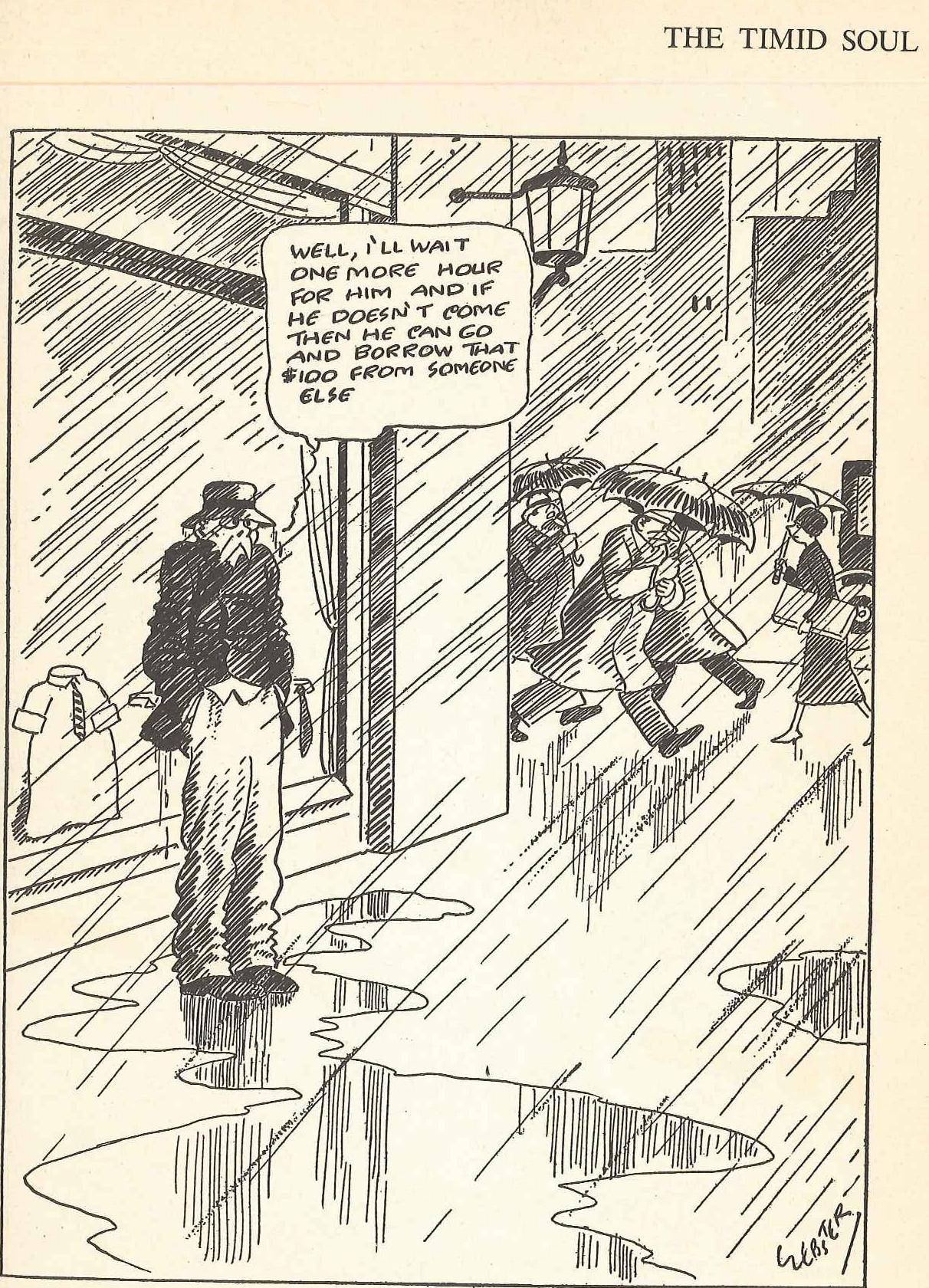
Milquetoast? Hmmm, how can I use this? The word “milquetoast,” since it’s an older reference now, comes from Caspar Milquetoast, the ne’er-be-bold main character of H.T. Webster’s one-panel comic strip “The Timid Soul.” Milquetoast came to mean anyone who was bland and easily pushed around. One of my favorite Milquetoast cartoons is here: http://www.cs.nyu.edu/faculty/davise/personal/milquetoast.gif. Hence, the main character of my story became Caspar.

I looked to see what Milquetoat’s wife might have been named, until I realized that Caspar’s actions were very similar to the non-fantasy life of Walter Mitty, the protagonist of the James Thurber classic short story “The Secret Life of Walter Mitty.” Since Walter’s wife was never named in the original story, Caspar’s wife here became Mittie.

Now, back to the issue of the kissing shadow. How did this picture come to be taken if Mittie is a sour old bitty? Enter a twist ending, a la O Henry with the common man misery of Kurt Vonnegut. How can I make the reality other than it appears? Well, the answer is in the story.